Research
XLID98 research is entering an exciting new phase. Around the world, scientists are working to better understand how the NEXMIF gene affects brain development while exploring multiple paths toward potential future treatments. Because XLID98 is so rare, every advance depends on collaboration between families, clinicians, researchers, and our growing international community.
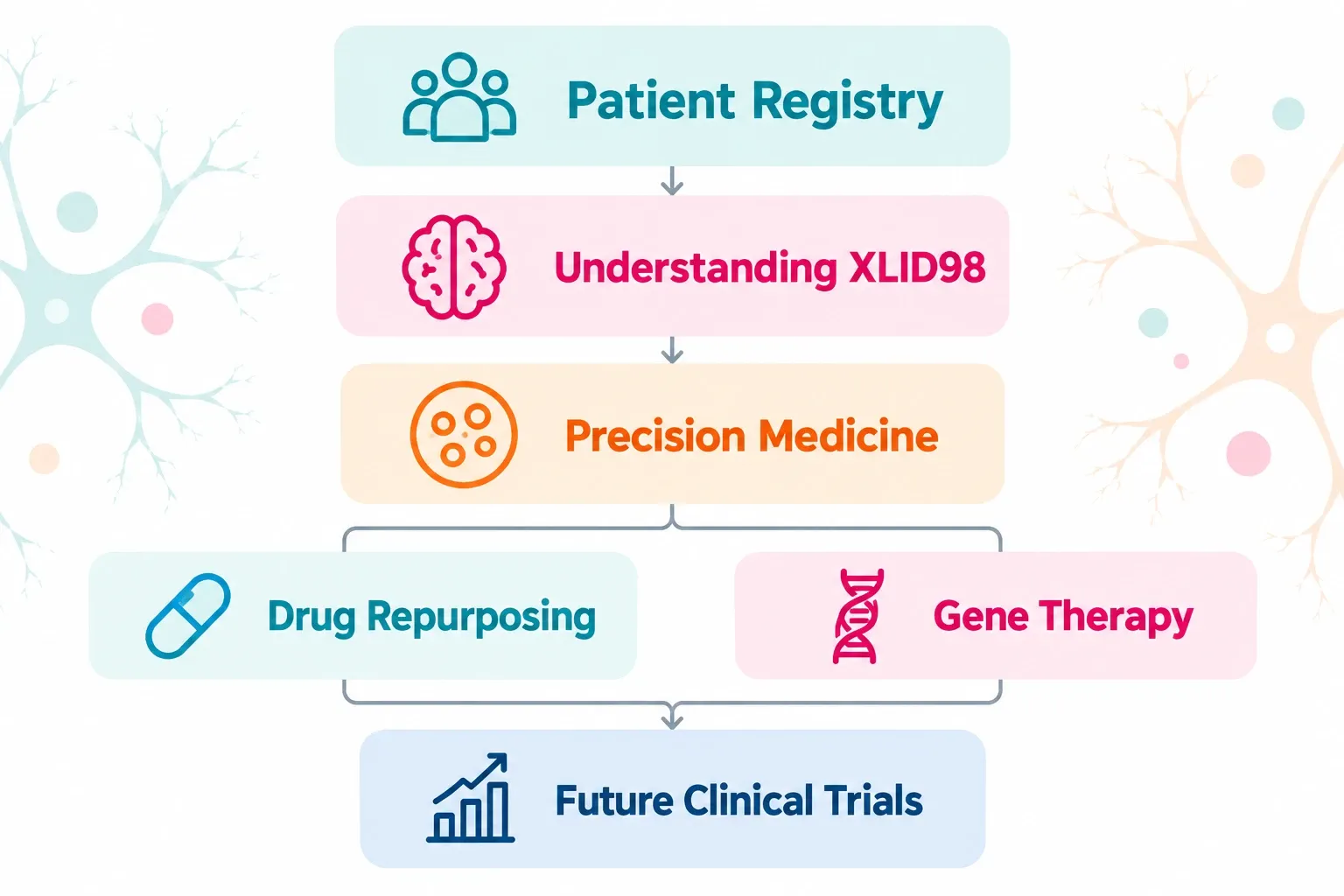
The XLID98 Foundation is committed to supporting research that can make a meaningful difference for families. Our current priorities include building the international registry, advancing gene therapy, investigating drug repurposing, and supporting precision medicine projects using patient-derived stem cells to test potential treatments. While these approaches are at different stages of development, together they bring us closer to safer, more effective therapies, and, ultimately, a cure.
Expected launch: Fall 2026
XLID98 International Registry
The XLID98 International Registry is a secure, global database that collects information about the symptoms, treatments, and experiences of people living with XLID98. Personal information is removed to protect each participant’s privacy. Built on the IAMRARE® Registry Platform from NORD (National Organization for Rare Disorders) and overseen by Queen’s University in Kingston, Ontario, Canada, the registry is expected to launch in Fall 2026.
The information collected will help researchers better understand XLID98 and is required by regulators before new treatments can be tested in clinical trials. Every family who joins the registry helps move research, and future treatments, one step closer.
Want to participate in research today? Our own registry is still in development. In the meantime, families can join Simons Searchlight (opens in a new tab), an independent international research program studying NEXMIF and many other genetic conditions.

Precision Medicine
We are also exploring precision medicine using cells donated by people with XLID98. These cells allow researchers to better understand how different genetic changes affect brain development and to test potential new treatments in the laboratory.
Learn about the Precision Medicine Project →
Why this matters
By testing new treatments in stem cells from people with XLID98, researchers can identify the most promising options before clinical trials begin.
Current status
The XLID98 Foundation is working with researchers to build a high-quality neuronal platform that can be shared with the wider research community.

Drug Repurposing
Some existing medicines may be able to improve specific aspects of XLID98. Because these drugs have already been tested for safety, repurposing could provide a faster path toward clinical studies.
Current status
The foundation is exploring collaborations with researchers and industry partners to identify the most promising candidates.

Gene Therapy
Gene therapy is a type of treatment that aims to fix the underlying cause of XLID98 by helping the NEXMIF gene work properly again. Researchers around the world are studying several possible approaches, including delivering a new, functional copy of the gene, switching on the healthy copy of the gene in females, and gene editing. These approaches are still being studied in the laboratory and are not yet available as treatments.
Latest progress
Our foundation is currently supporting and following multiple international gene therapy efforts. While no human clinical trials are yet underway for XLID98, recent laboratory studies have shown encouraging results.
Library of existing research
A handful of key published papers on XLID98 / NEXMIF, each with a plain-language summary beneath the title.
-
NEXMIF dosage and the developing brain (opens in a new tab)
Odamah K, et al. · Frontiers in Neuroscience · 2025
A companion 2025 study confirming the "Goldilocks" warning that too much NEXMIF is also harmful: the aim of any therapy is to restore normal levels, not exceed them.
-
Restoring NEXMIF expression rescues synaptic and behavioral deficits (opens in a new tab)
Odamah K, et al. · Translational Psychiatry · 2025
Restoring NEXMIF in newborn knockout mice brought back normal brain-cell maturation and improved social behaviour, repetitive behaviour, and learning, showing that at least some effects are reversible. The gene was delivered with a lentivirus, a lab tool rather than a therapy suitable for patients, and whether starting later works as well is still unknown.
-
NEXMIF encephalopathy: an X-linked disorder with male and female phenotypic patterns (opens in a new tab)
Stamberger H, et al. · Genetics in Medicine · 2021
The largest cohort to date (87 individuals: 63 female, 24 male). Developmental delay/intellectual disability was present in ~99% and epilepsy in ~83%; severity is highly variable.
-
Nexmif/Kidlia knock-out mouse demonstrates autism-like behaviors, memory deficits, and impairments in synapse and circuit function (opens in a new tab)
Gilbert J, et al. · The Journal of Neuroscience · 2020
A NEXMIF "knockout" mouse reproduces the human picture: autism-like behaviour, memory problems, and disrupted connections between brain cells.
-
De novo mutations of KIAA2022 in females cause intellectual disability and intractable epilepsy (opens in a new tab)
de Lange IM, et al. · Journal of Medical Genetics · 2016
Fourteen girls and women with a new (de novo) change in KIAA2022 (now called NEXMIF), most with intellectual disability and seizures that were hard to control. It established that females are often affected, and that epilepsy can be more prominent in females than in males.