Family handbook · §5
Behaviour & Communication
Most individuals with XLID98 have limited speech or are nonverbal, and many have intense behaviours, which can be among the hardest parts of daily life. Behaviour is communication. Even a nonverbal individual’s behaviour is telling you something.
A Framework for Understanding Behaviour
Dr. Tammy Dukewich (clinical psychologist and guardian of an individual with XLID98) offered two memory tools.
SEAT. Every behaviour has a function:
- Sensory: a need to change sensory input, including pain, hunger, toileting;
- Escape/avoidance: a task feels too hard, and ability isn’t fixed (managing something yesterday doesn’t mean an individual can today);
- Attention: wanting engagement, which is not a bad thing; and
- Tangibles: wanting access to something or someone.
When an individual can’t self-regulate, the “feeling brain” takes over and the “thinking brain” goes offline; what helps is co-regulation: staying calm and kindly taking charge (the hardest part).
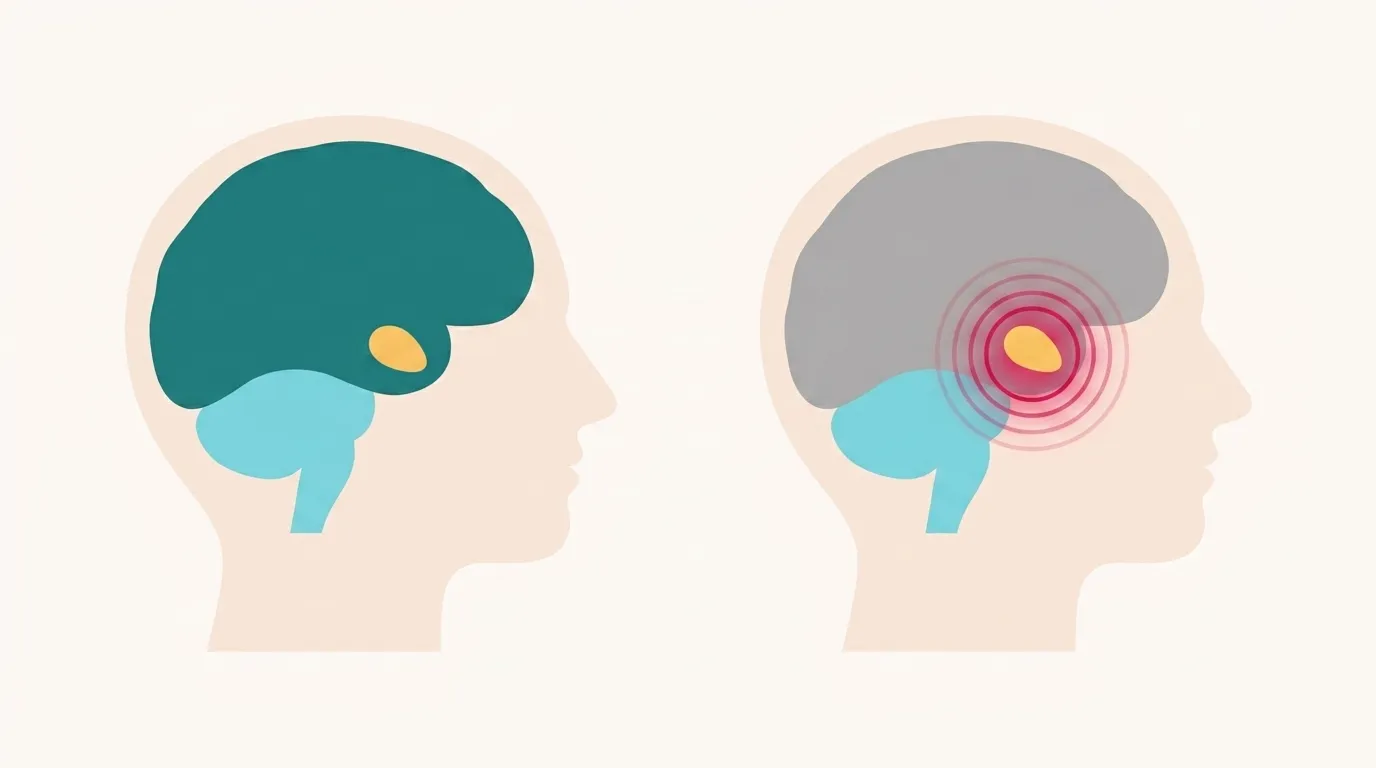
Calm (left): the thinking brain, the teal cortex, stays online. Under high emotion (right), the amygdala (gold) sounds the alarm and the cortex goes offline (grey). That is why co-regulation, not reasoning, is what reaches a dysregulated person.
Her caregiver tool SOOTHE:
- Soft tone with few words;
- Organize through routine;
- Offer simple choices;
- Touch/closeness when welcome;
- Hear what’s really driving it; and
- End by returning to baseline before re-engaging.
A practical tip: don’t tell an individual to calm down; breathe with them.
Communication: What Families Use
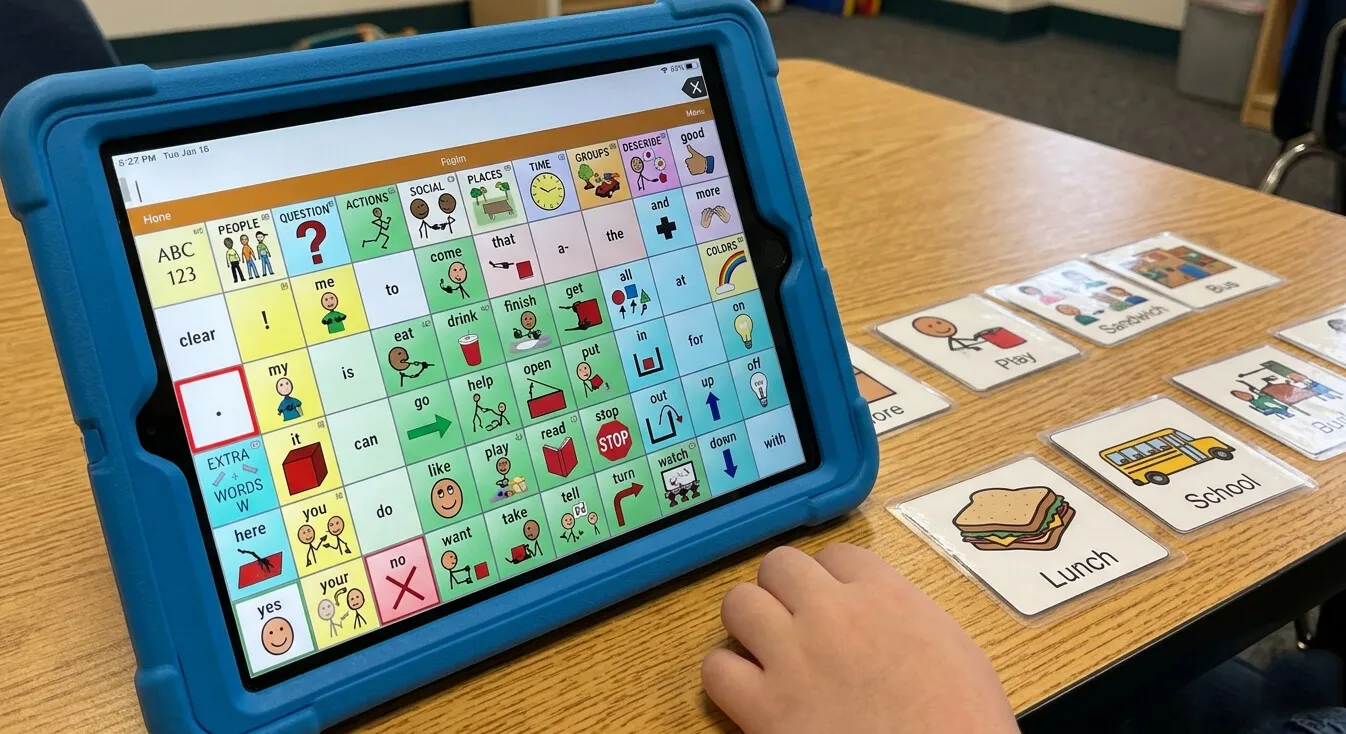
- Approaches that helped: sign language and Key Word Signing, cue cards with repetition, communication apps, and AAC speech devices.
- Transition/referral objects. Many individuals understand tone and context even without words.
- Speech varies enormously.
Sensory Needs and Self-Injury
- Sensory sensitivities are common, especially to sound and touch.
- Self-injurious and self-stimulating behaviours include head-banging, biting, hair-pulling, self-gagging, and wrapping objects around limbs. Deep pressure helps ground an individual and reduces biting, spitting, pinching, and hair-pulling.
- Triggers: tiredness (especially after many seizures), hunger, frustration, and unfamiliar situations.
Individuals differ: under-responders seek more input (crashing, jumping, touching everything), while over-responders avoid intense sound, light, smells, or touch, and some shift between the two. Rather than simply stopping a sensory behaviour, give a safe replacement (chew toys or chewable jewelry for an individual who mouths things) and build a “sensory diet” with an occupational therapist. Two often-overlooked channels: vestibular (movement: gentle lateral rocking tends to calm, while spinning revs an individual up, making it a poor pre-bedtime choice) and proprioceptive (deep pressure to muscles and joints, which many individuals find grounding). For escape or avoidance, teach the individual to request a break (a sign, device, or “break” card), break tasks into small steps with specific praise, and use first-then or token boards with visuals. For more on understanding sensory needs day to day, the parent handbook Understanding Your Child’s Sensory Signals (opens in a new tab) by Angie Voss, OTR is a practical reference.
XLID98 Foundation · https://www.xlid98.org/parent-resources/behavior-and-communication