Research program
Gene Therapy for XLID98
What Is Gene Therapy?

Gene therapy is a type of medical treatment whose goal is to treat or even cure a disease by fixing genes that are missing or not working the right way. Many health conditions (including XLID98) happen because a gene isn’t working properly. Scientists are looking at three different levels where they can fix the problem: DNA, RNA, or protein.
For XLID98, gene therapy could work in a few different ways:
- Adding a new, healthy copy of the gene that works correctly
- Repairing (also called “editing”) the gene that isn’t working the way it should
Scientists are also studying ways to turn certain genes “on” or “off” in the body without actually changing the gene itself. This is called epigenetic therapy.
Gene therapy is still a fairly new area of science, and researchers are working hard to make sure these treatments are safe. Right now, it is the main treatment being studied for diseases that don’t have any other cure. That’s exactly why it gives so much hope to the XLID98 community.
Why XLID98 Is a Promising Candidate
Gene therapy could be a life-changing treatment for people with XLID98. The good news is that XLID98 may be a strong fit for this kind of treatment. That’s because we know it is caused by a change (called a mutation) in just one gene, called NEXMIF. This gives researchers a clear target to aim for.
In simple terms, gene therapy would work by delivering or fixing the NEXMIF gene so the cells that need it have a healthy, working copy. This would treat the main cause of XLID98, not just the symptoms. If it works, this kind of treatment could improve many parts of a person’s growth, learning, and daily life.
But It’s More Complicated Than Simply Replacing a Gene
One of the biggest challenges is getting the amount of NEXMIF protein just right. Too little causes XLID98, but research suggests too much may also be harmful. Because of this, scientists are exploring several different approaches rather than relying on a single treatment strategy.
Current Approaches
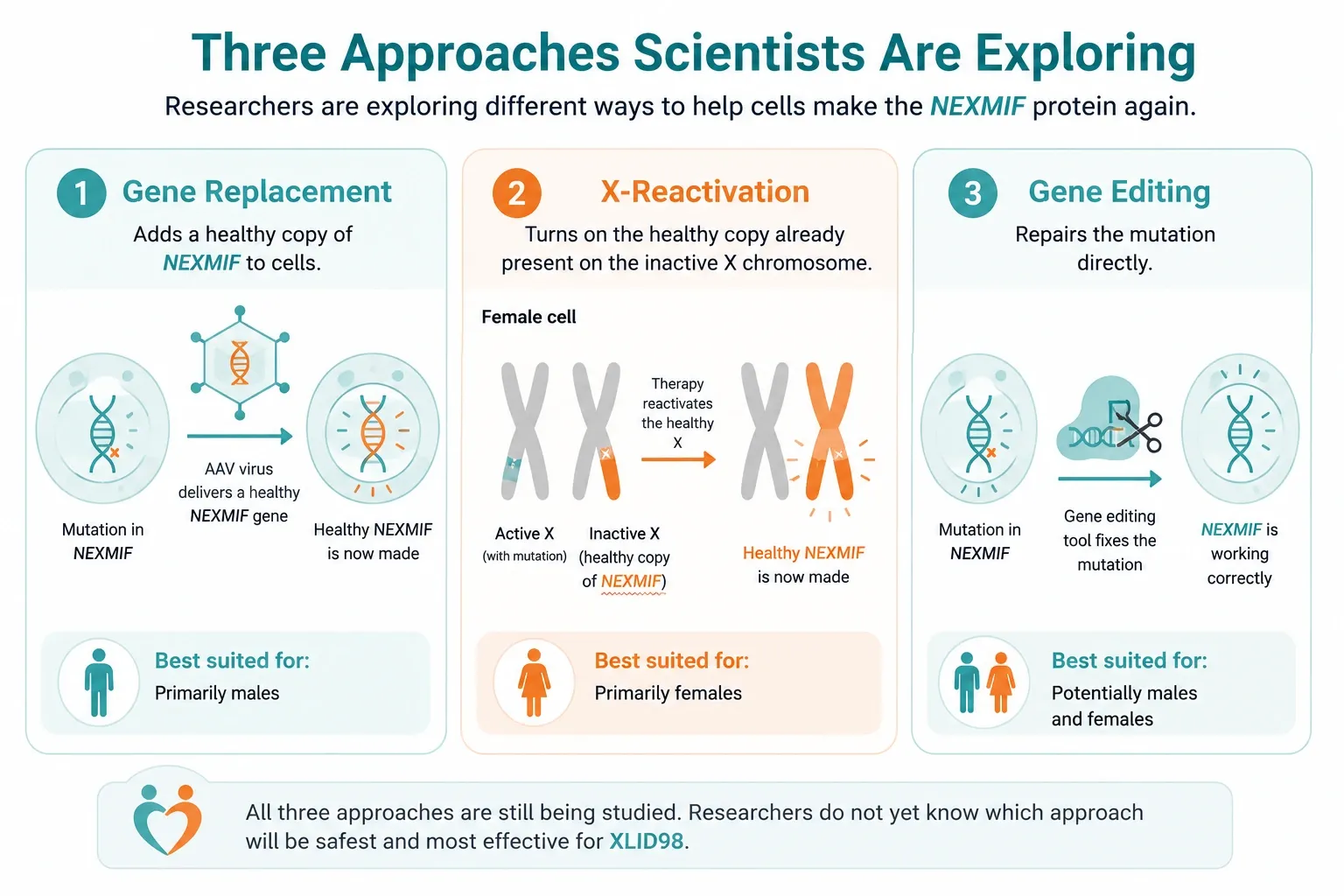
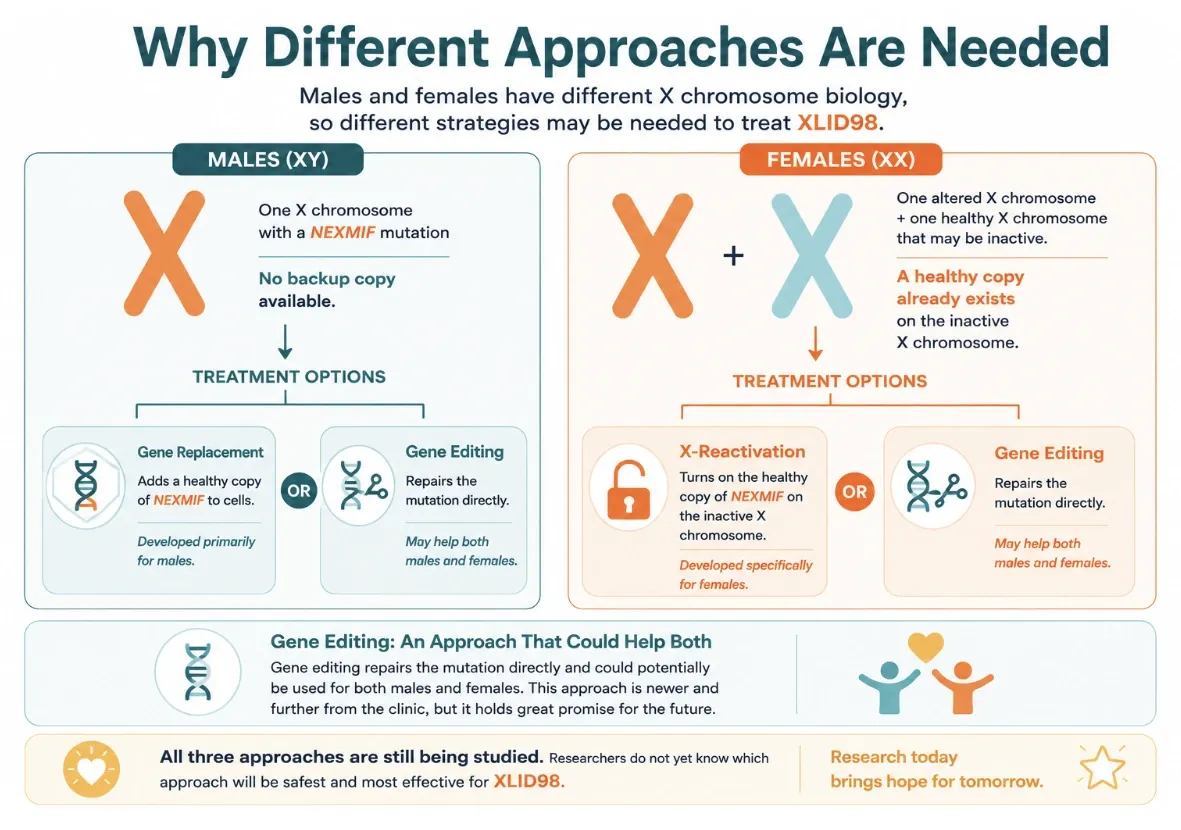
Researchers are still working to learn how well gene therapy can help when it is started later in life, not only early on. We don’t know this for certain yet, but there is good reason to believe it can still bring meaningful benefit at later stages of life. Understanding how much it can help at each stage is an active focus of research right now.
Reasons for Encouragement
Studies in mice have shown encouraging results. Researchers were able to restore the NEXMIF gene after birth, leading to better memory, improved social behaviour, and fewer repetitive behaviours. This suggests that treatment may still help even after the brain has started developing.
Scientists have growing evidence that some effects of XLID98 may be reversible. In a 2025 study, restoring NEXMIF in mice improved brain-cell development, learning, and social behaviour. This is an exciting step forward, although the treatment was given to newborn mice, so researchers are still studying how well it might work later in life.
The Road to a Gene Therapy
Getting from the lab to a treatment happens in stages, and these steps overlap. Researchers put the overall timeline to first patients at roughly 5–10 years (about five at the very least), potentially faster with strong funding, with the honest caution that “going faster doesn’t guarantee arriving sooner.”
Phase 1: Understand the biology of XLID98 (underway) Before we can treat XLID98, we need to fully understand it. Researchers are studying the NEXMIF gene, the protein it produces, and how the change affects brain development, while building a picture of how XLID98 affects people throughout their lives. Identifying NEXMIF (previously known as KIAA2022) as the cause is done; understanding the gene’s function, building the registry, and studying animal models are in progress.
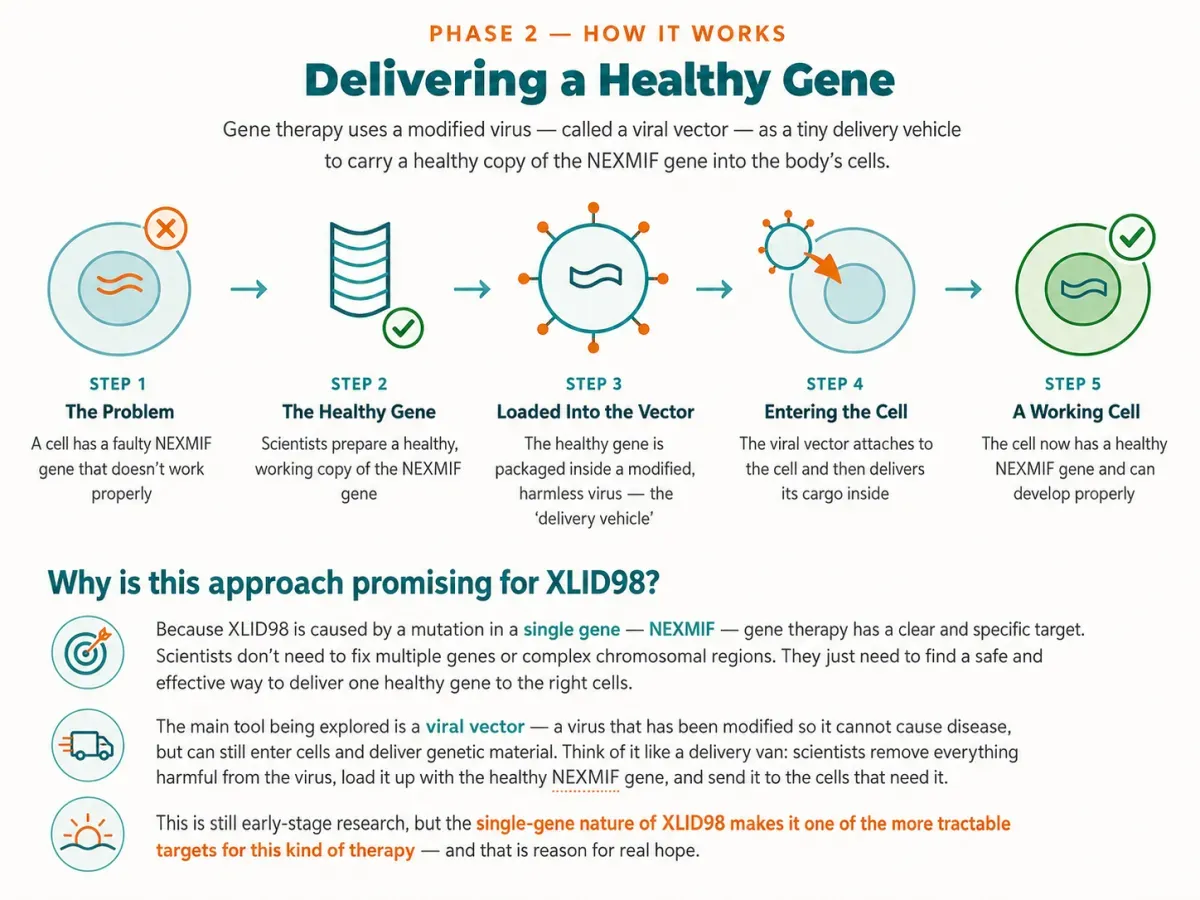
Phase 2: Can we correct the gene’s activity? (testing in animals in progress) In parallel, the goal is to find the best way to deliver a working copy of the NEXMIF gene (or to switch the healthy copy back on) in the cells that need it. Scientists are testing different methods, starting with viral vectors (tiny delivery vehicles that carry genetic material into cells) and stem-cell research.
Phase 3: Is it safe? (ahead) Before any treatment can be used in people, it must be shown to be safe in animals. The therapy goes through thorough safety and toxicology testing in animals first. This step is required before any human trials can begin.

Phase 4: Testing in humans (future) The goal: a clinical trial. This is where the journey leads. Once the therapy has been safely dosed in animals, researchers will prepare a full application to run a clinical trial. Researchers will then apply to a regulatory agency, such as Health Canada or the U.S. FDA, for approval to begin a clinical trial: the first step toward testing the treatment in people with XLID98. Reaching this phase would be a historic milestone for our community.
- Submit clinical trial application to Health Canada and the FDA
- Begin first-in-human safety testing